Almost Halfway There: But Most Australians Think The Grid Rebuild Has Barely Begun
16 Sep 2026
|
News
|
Media releases
- 76% say finish the job, almost 60% warn ageing coal is unsafe and unreliable, and 87% demand the cheapest electricity future
- Industry body says national debate is distorted as Australians think energy transition has barely started
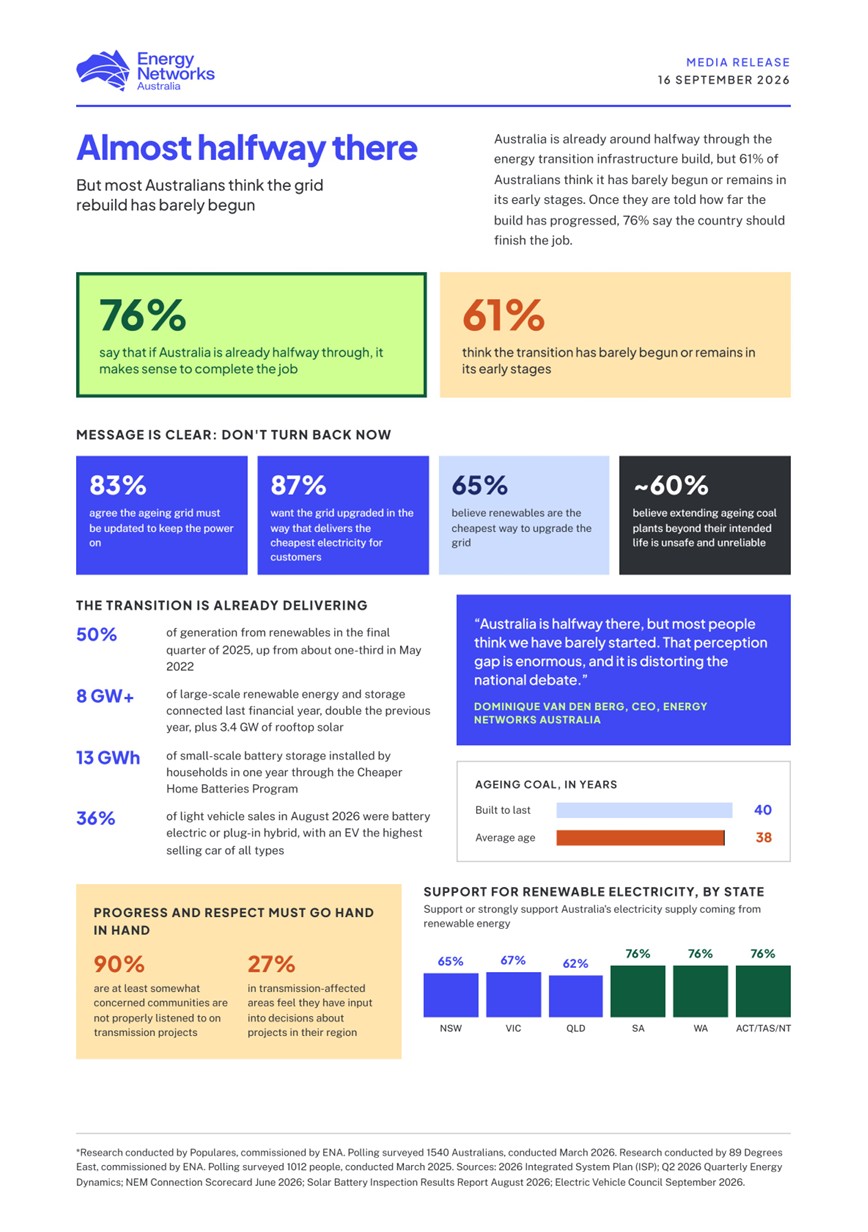
Australia is already around halfway through the energy transition infrastructure build, but 61% of Australians think it has barely begun or remains in its early stages.
National polling exposes a striking Perception Gap: once Australians are told how far the build has progressed, 76% say the country should finish the job.
It also delivers a blunt verdict on ageing coal. Almost 60% believe running coal-fired power stations beyond the life they were built for is unsafe and unreliable. The plants were built to last up to 40 years. Their average age is already 38.
On cost, Australians are equally clear. The most persuasive message tested was: “If we need to upgrade our electricity grid anyway, we should do so in the way that ensures the cheapest electricity for customers in the future.”
MESSAGE IS CLEAR: DON’T TURN BACK NOW
- 83% agree the ageing grid must be updated to keep the power on.
- 87% want the grid upgraded in the way that delivers the cheapest electricity for customers in the future.
- 76% say that if Australia is already halfway through, it makes sense to complete the job.
- 65% believe renewables are the cheapest way to upgrade the grid.
- Almost 60% believe extending ageing coal plants beyond their intended life is unsafe and unreliable.
Energy Networks Australia Chief Executive Officer Dominique van den Berg said Australians had delivered a decisive message: do not turn back halfway.
She said the results showed the effectiveness of the energy transition to date to achieve so much with communities embracing evolutions such as solar, batteries and EV chargers.
“Australia is halfway there, but most people think we have barely started. That perception gap is enormous, and it is distorting the national debate,” Ms van den Berg said.
“Once Australians see the progress, 76% say finish the job. They know the grid is ageing, they know doing nothing will cost more, and they want the rebuild to deliver the cheapest electricity possible over the long term.”
“The choice is not between upgrading the grid and avoiding cost. The choice is whether we do it efficiently now or force customers to pay more later.”
“And Australians are not buying the argument that ageing coal can simply be pushed on indefinitely. Almost 60% say running plants beyond their intended life is unsafe and unreliable.”
THE ENERGY TRANSITION IS ALREADY DELIVERING
While many Australians believe the transition is still at the starting line, the system has already changed dramatically:
- Renewables grew from about one-third of generation in May 2022 to 50% in the final quarter of 2025, with every quarter of 2026 setting a new record for that quarter.
- More than 8 GW of large-scale renewable energy and storage connected in the last financial year, double the previous year, plus 3.4 GW of rooftop solar.
- Australia is a global leader in rooftop solar and household batteries. Households installed more than 13 GWh of small-scale battery storage in one year through the Cheaper Home Batteries Program.
- Combined Battery Electric Vehicles and plug-in hybrids reached 36% of light vehicle sales in August 2026, with an EV being the highest selling car of all types in Australia.
“This is not a transition waiting to begin. It is happening now, in the grid and in millions of homes and businesses across our nation,” Ms van den Berg said.
“The priority is to complete the build at the lowest sustainable cost, keep reliability front and centre, and make sure communities can see both the progress and the benefits.”
PROGRESS AND RESPECT MUST GO HAND-IN-HAND
Polling also carries a warning for project delivery. Ninety per cent of Australians are at least somewhat concerned that communities are not properly listened to when transmission projects are developed. In transmission-affected areas, only 27% feel they have input into decisions about projects in their region.
“People support the destination, but industry and government must earn trust in how we get there. Communities need an authentic voice, clear benefits and honest information about what is being built and why,” Ms van den Berg said.
“Every kilometre of transmission line and every new piece of energy infrastructure affects real people, real properties and real communities.”
“Fairness and respect must remain at the centre of the transition,” she said.
“Australians support the transition, but they also expect us to be sensitive to the people and communities living with the impacts of new infrastructure. Progress and respect must go hand in hand.”
-ends-
*Energy Networks Australia is the national industry body representing Australia’s electricity transmission and distribution and gas distribution networks. Our members provide more than 16 million electricity and gas connections to almost every home and business across Australia.
Media enquiries: Kristina Zarich | news@energynetworks.com.au | 0499 396 217
METHODOLOGY AND SOURCES
Research conducted by Populares, commissioned by ENA. Polling surveyed 1540 Australians, conducted March 2026.
Research conducted by Populares, commissioned by ENA. Polling surveyed 1540 Australians, conducted March 2026.
Research conducted by 89 Degrees East, commissioned by ENA. Polling surveyed 1012 people, conducted March 2025.
Sources:
2026 Integrated System Plan (ISP)
Q2 2026 – Quarterly Energy Dynamics
NEM Connection Scorecard – June 2026
Solar Battery Inspection Results Report – August 2026
Electric Vehicle Council – September 2026
2026 Integrated System Plan (ISP)
Q2 2026 – Quarterly Energy Dynamics
NEM Connection Scorecard – June 2026
Solar Battery Inspection Results Report – August 2026
Electric Vehicle Council – September 2026